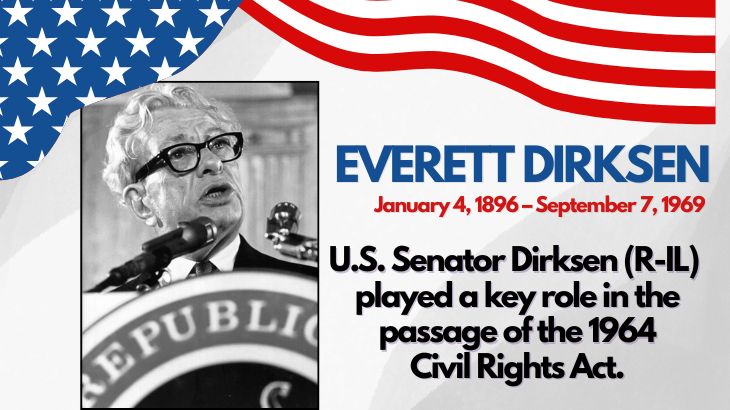
United States Senator, Republican Everett Dirksen
“The Forgotten Civil Rights Champion”
That’s the moniker the Smithsonian gave to Everett Dirksen for his efforts to pass the Civil Rights Act of 1964. Few Illinoisans are likely familiar with Dirksen’s efforts, but they should be, especially in 2025.
Sixty years after the Civil Rights Act and Voting Rights Act of 1965 were passed, the race hustle in Illinois continues.
Chicago is under the control of racist Mayor Brandon Johnson, who famously said last year he was too busy to visit the border, at the height of the crisis, “with a black wife raising three black children on the west side of the city of Chicago.” A couple of weeks ago, Johnson bragged about all the Blacks he has put into high places in his administration, naming them specifically and noting their Blackness. His remarks show we are not in a post-racial moment from his perspective. He now finds himself under a civil rights investigation by President Trump’s Department of Justice, and rightly so.
Meanwhile, the Illinois legislature continues to pass bills requiring minority set-asides, scholarships, or policies directed at helping one racial group over others. Still pending is the race-based higher education funding bill, and this week, there is yet another story about preferential admissions to minorities into SIU Medical School. (See below)
When racial politics overlay every decision in this state, maybe it’s time for people to know more about Republican Everett Dirksen and his efforts to end such at a time far more racially divided than now.
This isn’t 1960, and America elected its first Black President 17 years ago; it’s time we understand better the impact of the Civil Rights Act.
Interestingly, it is this very act that is now being used to take colleges to court over race-based admissions, investigate Mayor Johnson for possibly violating the law in his hiring decisions, and prohibit DEI policies throughout the government.
In 1964, America still harbored discriminatory practices and unfairness against Blacks in many parts of the country. Separate but equal educational settings, redlining in financial decisions, and hiring discrimination were both subtly and overtly practiced. While President Kennedy proposed Civil Rights legislation to correct the practice, a controlling number in his party from Southern states opposed such a bill, and Kennedy was murdered before he could muscle it through Congress.
The National Archives summarizes the Act as follows:
The act outlawed segregation in businesses such as theaters, restaurants, and hotels. It banned discriminatory practices in employment and ended segregation in public places such as swimming pools, libraries, and public schools.
Title VII of the act created the Equal Employment Opportunity Commission (EEOC) to implement the law. The EEOC enforces laws that prohibit discrimination based on race, color, religion, sex, national origin, disability, or age in hiring, promoting, firing, setting wages, testing, training, apprenticeship, and all other terms and conditions of employment.
Southern Democrats strongly opposed the Act, and they filibustered for 60 days, making it the longest continuous debate in Senate history. The debate ended when Everett Dirksen, Senate Minority Leader, convinced 27 Republicans (out of 34) to vote for cloture, which ended the debate. Nine days later, the Civil Rights Act of 1964 was passed 73-27.
Dirksen did not just cajole his Republican colleagues. He pored over the bill and amended parts of it to ensure passage.
The Smithsonian wrote this about his efforts;
“June 10, 1964, was a dramatic day in the United States Senate. For the first time in its history, cloture was invoked on a civil rights bill, ending a record-breaking filibuster that had consumed fifty-seven working days. The hero of the hour was minority leader Senator Everett McKinley Dirksen (R-Ill.).
Dirksen, who had little support among Chicago’s black voters and who had been picketed at his home by rights activists, took pains to point out that he was “no Johnny-come lately” to civil rights legislation. During his sixteen years in the House of Representatives, he had voted for anti-poll-tax and anti-lynching measures. In the Senate he had sponsored or cosponsored scores of bills dealing with civil rights. But as an omnibus civil rights bill began to near passage in the House early in 1964, Dirksen, a pragmatic legislator and a consummate compromiser, realized that its provisions were too drastic for passage in the Senate.”
At Breakthrough Ideas, we thought it was time to honor someone with an Everett Dirksen Award. It is the idea of our social media director, Babette Holder, and the award is given to someone who truly embodies the work towards a post-racial USA and understands fully that equal opportunity is at the core of American principles.
This year, we invite our followers to join us for a special evening to reflect on the Civil Rights movement and assess our progress. We will honor Pastor Corey Brooks for his work with the Everett Dirksen Award.

IN OTHER NEWS
- Climate Change, Energy and Public Policy: Fact and Fiction
https://www.youtube.com/live/HN-2gSWLC3I?si=DlDpCkhQlSHgxjdb
Listen to Steve Goreham present information on the energy situation in Illinois. Steve is a graduate of the University of Illinois, author of four books on climate and energy, a frequent speaker on these topics, and the Executive Director of the Climate Science Coalition of America.
His website is https://www.stevegoreham.com/
- By Steve Cortez – Don’t Fund Chinese Companies in the Tax Bill
https://amgreatness.com/2025/05/22/dont-fund-chinese-companies-in-the-tax-bill
- News Channel 20 – Ameren Illinois customers face 50% electricity rate hike from June 1 due to new pricing
- Daily Wire – About Southern Illinois University
Med School Caught Rejecting White And Asian Applicants With Better Scores Than Minorities It Accepts
- City Journal, Christopher Rufo – Harvard Researcher: The University Is “Totally Corrupted”
https://www.city-journal.org/article/harvard-university-left-bias-trump-omar-sultan-haque