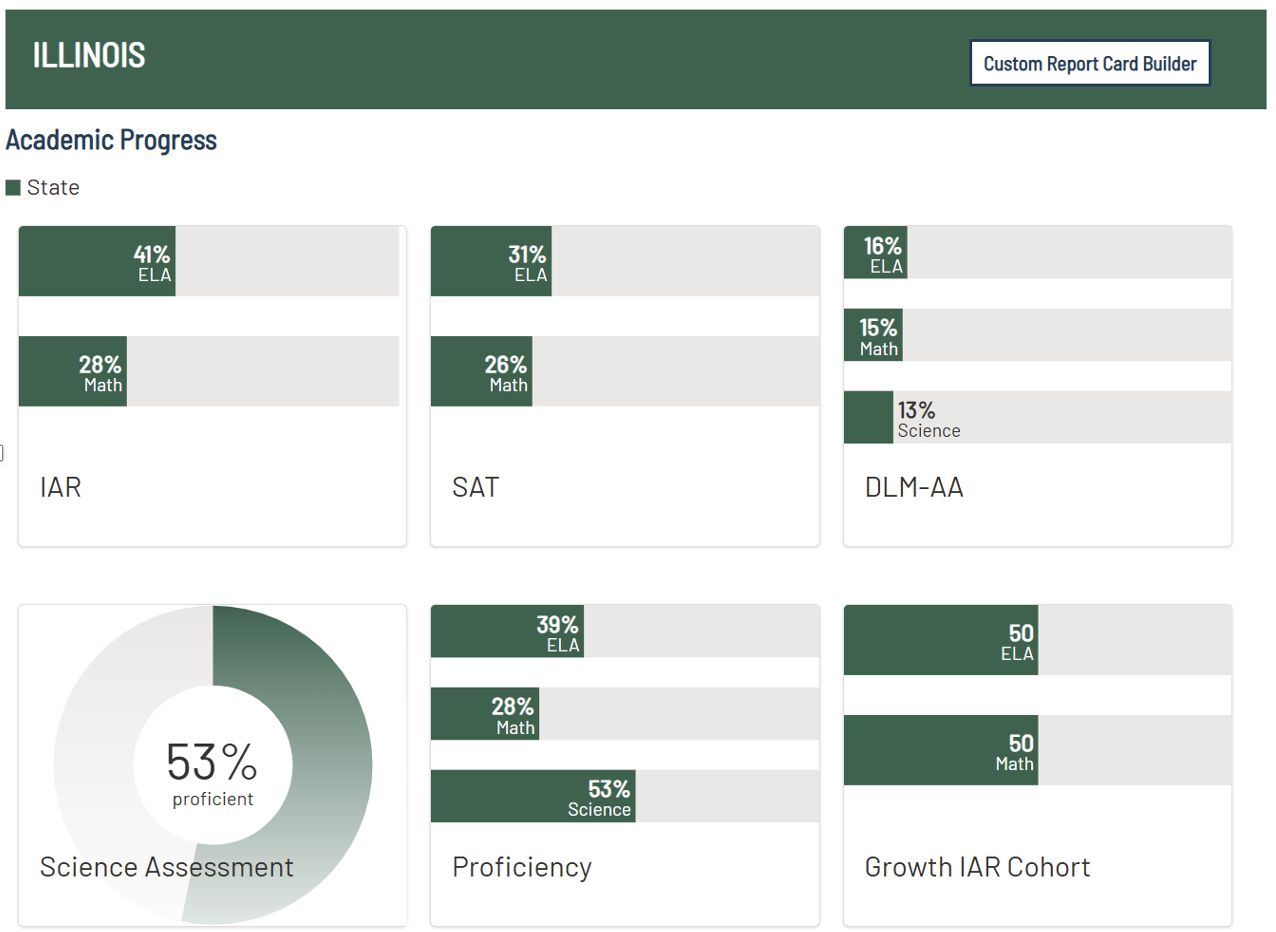
The elitists in the education bureaucracy are monkeying with the state standards that measure proficiency. Since 2019, the number of students who score as “meets or exceeds proficiency” has not increased in 3 out of 4 tests and only slightly increased in one.
The state measures proficiency in math and reading at the elementary level using the Illinois Assessment of Readiness (IAR) and at the high school level using the SAT.
This chart from the Illinois State Board of Education Report Card shows the overall state-level proficiency over the years in the IAR test for English Language Arts. In 2019, 37.8% of students were considered proficient in ELA. In 2024, 41.2% of students met or exceeded proficiency. This is the only category of improvement over this timeframe.

For IAR Math Proficiency, in 2019, 31.8% were proficient and in 2024, 28.4%.

For the SAT, 2019 the number of students proficient in ELA was 36.3% and in 2024, 31.1%.

For SAT, 2019, Math proficiency was 34.4% and 2024, 26.1%.

More people are getting familiar with this data, and parents armed with the information are asking why their schools are doing so poorly that they can’t even educate 50% of the students.
In fact, the SAT may be the most alarming score when you think about it. After attending 12 years in public schools (the SAT is taken in 11th grade), right now, in a modern, highly technical world with information and online tutoring programs ubiquitous, less than a third of the students are considered proficient in reading and math in Illinois.
What to do?
Well, the solution by the Educrats (the education bureaucrats which include: state board members, school administrators, teacher union leaders, education associations, and elected school boards) is to change the cut scores so more students rate as proficient.
They are also changing the test – again. Illinois moved from the ACT to the SAT in 2016 and now they are moving back to the ACT. This prevents consistent measurement across the years. Before the switch to SAT, the ACT had been the required test for high schoolers for 15 years.
The state board of education has a new scoring system to measure proficiency. If you want to dive deeper into the how they are adjusting the scores, here is their webpage: https://www.isbe.net/feedback
They argue that the new scores will align our state standards with the National Assessment of Education Progress standards, the Nation’s Report Card, which they say show that Illinois students do better than other students on the national tests. Those tests biannually grade 4th and 8th graders on math and reading.
That argument falls apart, however, unless you want to thinly slice the data between very small differences in scores.
Averaging the data across all four metrics, Illinois student scores were not significantly different than 28 other states and were lower than 6 other states.
Here is a link where one can access the data:
Here’s the NAEP data for Illinois 4th Grade Reading. In the lower left corner of each chart is the information on how Illinois compares to other states.

Here’s 4th Grade Math

Here’s 8th Grade Reading

Here’s 4th Grade Math

The realignment of the cut scores to better reflect Illinois student achievement compared to other states is all part of the bigger program the Educrats are rolling out for legislative approval. They call the Plan Vision 2030.
This plan follows Vision 2020 which they began rolling out in 2013 and which culminated in the 2017 passage of the Evidenced-based funding plan that has poured over $10 billion more into education from state taxpayers in just seven years. As you see the results are dismal – there’s been little improvement. But, the likely response by the bureaucrats would be that if we didn’t have the money, just imagine how much worse off our students would be.
The Vision 2030 plan, linked HERE, has all the buzz words one can only come up with if they have a PhD in education. It is, of course, according to the supporters, a plan backed by granular research from other equally over-educated PhDs that have finally come up with the secret ingredient to robust student achievement.
What is that secret ingredient? More Money.
Of course, it’s always about the money.
Illinois is spending $15.9 billion in state and federal money for PreK-12th grade this year and $30 billion more, at least, in local property taxes and still less than a third of students are proficient by the time they graduate.
When they realign the test scores, there is little doubt that still less than 50% of students will be considered proficient. Will that make anyone feel better?
The Chicago Tribune wrote this about the chang in test scores:
First, the scores needed to be considered “proficient” are going down for math and reading.
For high schoolers, these scores come from the preACT and the ACT, a test with scores ranging from 1 at the low end to 36 on the high end.
Previously, the state used SAT scores to measure high school proficiency, with proficiency standards above the national average.
Now, scoring an 18 in English language arts and a 19 in math on the ACT will count as “proficient” for high school juniors. To put that in perspective: an 18 is below the national average ACT score of 19 — and far below what selective universities such as the University of Illinois expect, where most freshmen scored between 30 and 34.
For students in lower grades, the same trend holds true — proficiency scores based on the Illinois Assessment of Readiness for English and math went down, while science went up slightly.
Second, it’s about to become a lot more difficult to understand how students are doing.
Education reporter Becky Vevea of Chalkbeat hit the nail on the head when she wrote that, “Comparisons to achievement in past years, including to pre-pandemic performance, now will be difficult due to the shifting benchmarks.”
Yes. And while state officials make the case that this was a necessary change, we wonder cynically whether this move was about obfuscating continued declines.
The decision stems from the Board’s 18-month-long process of consulting with over 100 educators and other local higher education stakeholders to establish new proficiency benchmarks.
A FOX News article said this about why the decision was made:
The Board said that such benchmarks are based on analysis of “college and university course placement data and student probabilities of passing college coursework” and success data from Illinois colleges and universities
The effectiveness of public universities in supporting students to earn their degrees on time has significant implications for individuals, families, and state economies. One of the key measures of institutional success is the graduation rate—how efficiently and consistently universities help students achieve their educational goals. In this report, we present a comprehensive 50-state comparison of four critical metrics: the first-year retention rate, the 4- year graduation rate, the 6-year graduation rate, and the transfer-out rate among public universities.
To be clear, this report is related to public universities.
Illinois has a 4-year graduation rate of 34%. The six-year graduation rate is 52%.
The national average is 34% and 50% respectively.Two things here. First, once again, our students are achieving at the same level as the nation as a whole. So changing SAT and IAR cut scores to align with student college success, doesn’t seem to make sense. Second, a 34% four-year graduation rate is terrible. How much money are we wasting in higher education? Shouldn’t we have more students graduating in just three years with all the AP and dual credit class we have now at the high school level? Shouldn’t students be graduating with combined bachelor’s and masters or law degrees in six years, as many universities are offering these hybrid programs?
From mandated mental health screening to new scoring to mask underachievement, to another Illinois school making national news for dangerously allowing a boy to be on the girls’ volleyball team, Illinois education is a mess.
It’s time for parents concerned about their children and grandchildren’s future in this state to run for school board.