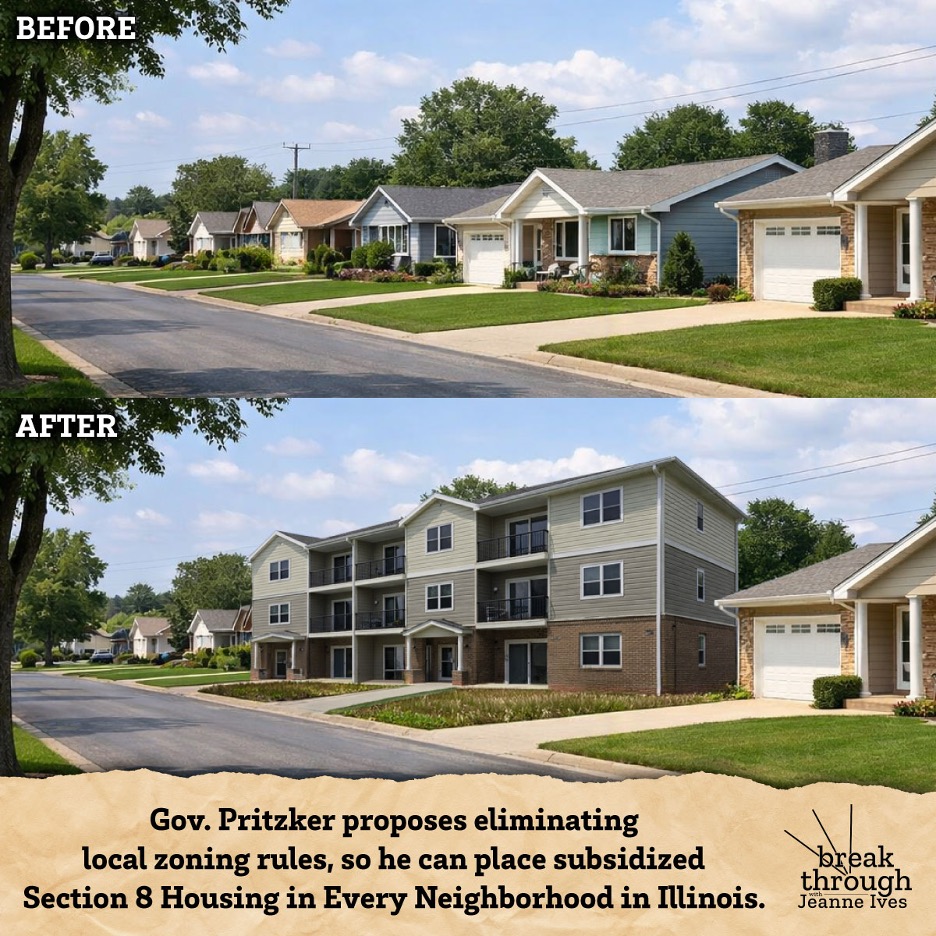
The most alarming proposition in Governor Pritzker’s budget address was not that it is another record budget, up nearly a billion, that includes tax increases, but that under the guise of “affordable housing,” Pritzker is proposing statewide zoning laws that would bring Section 8, subsidized housing, to every neighborhood.
Pritzker cited a study by the University of Illinois showing that the state is short 227,000 homes and that “rent is too high and home ownership is too far out of reach” because “We are not building enough homes fast enough.”
In a DuPage Policy Journal article about this plan, cited below, they refute these housing shortage numbers, noting that:
According to Chicago Cityscape, the City of Chicago had 31,086 vacant properties as of March 2023, and Cook County had an additional 28,308 vacant lots.
The U.S. Census Bureau’s 2023 American Community Survey estimated that the City of Chicago has 121,652 vacant housing units, or a rate of 9.5 percent.
It’s a myth that the housing doesn’t exist. It’s more likely that the housing isn’t in the neighborhoods people want to be in.
Pritzker then pointed to “shameful” local regulation as the problem.
In many places, local regulations have made it too difficult and costly to build new housing. Some of the rules even have shameful roots that go back to the days of redlining. Often, the problem is a failure to modernize and keep up with the changing times we live in. It all adds up to bureaucratic red tape that unnecessarily increases costs, delays construction, and frequently kills projects altogether.
For example, local parking mandates often require a uniform minimum number of spaces for every new build – even in places where people don’t have cars because they have ample public transit and available street parking.
He announced his “Building Up Illinois Developments or BUILD Plan – an initiative to lower housing costs by making it easier, faster, and more cost-effective to build homes in Illinois.”
According to him, this is “an ambitious slate of reforms designed to eliminate unnecessary barriers and lower costs for housing construction, produce a wider range of family-friendly housing types, and streamline construction processes.”
Most importantly, Pritzker said –
City by city, town by town, neighborhood by neighborhood, block by block – a little more housing in each area can significantly advance our housing stock.
He is saying that his plan will put multi-family dwellings on your street – and he is going to make you pay for it.
We’ll add to that a robust approach to closing financing gaps for developing housing of all kinds – from targeted funds for smaller projects to direct support to local communities so they can clear initial hurdles and make housing sites build-ready.
These ideas are dangerous and will destroy neighborhoods just as similar policies have done in the south suburbs. Steve Cortes, who grew up in Park Forest, responded to Pritzker’s Section 8 proposal on his X account
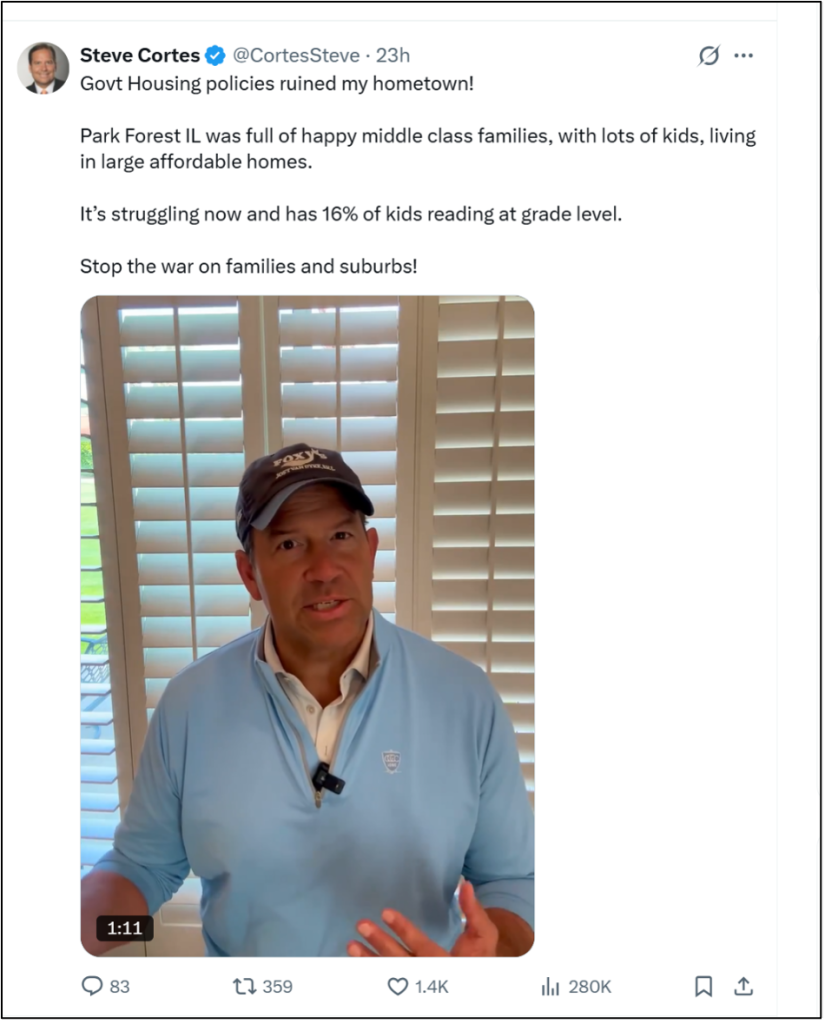
If you are on X, click the link and hear Cortes’ minute commentary on the topic and read the comments that support what he is saying. Cortes will be on The Real Story tomorrow at 11 am on AM 560 to discuss this topic
This DuPage Policy Journal article, states that the plan is to force multi-family dwellings on any lot size that is greater than 2,500 square feet. For perspective, 2,500 square feet is “ 20 percent smaller than a standard 25 by 125 (3,125 square foot) City of Chicago lot.”
DPJ also wrote:
Pritzker’s plan would mandate that anyone could build a four-flat of Section 8 apartments on any 2,500 square-foot suburban lot in Illinois, a six-flat on a 5,000 square foot lot and an eight-flat on a 7,500 square foot lot.
Elmhurst’s minimum residential lot size is 7,260 to 9,000 square feet. Naperville’s is 10,000 square feet for single family homes.
In Glen Ellyn, minimum lot sizes range from 7,500 to 40,000 square feet, in Hinsdale they are 10,000 to 30,000 square feet and in Wheaton, 6,500 to 43,560 square feet.
In Downers Grove, the minimum lot size for new construction is 10,500 square feet.
For doubters that this is Pritzker’s plan, Capitol News Illinois said the same thing in this article Pritzker to propose statewide zoning laws to spur homebuilding, limit local control.
Local zoning boards would no longer be allowed to prohibit property owners from building multi-unit housing on residential lots exceeding 2,500 square feet.
It would be on a sliding scale, with lots smaller than 2,500 square feet limited by right to single-unit housing. Lots between 2,500 and 5,000 square feet could hold up to four units; those between 5,000 and 7,500 square feet up to six units; and lots larger than 7,500 square feet up to eight units. The plan would also bar municipalities from requiring minimum lot sizes greater than 2,500 square feet for detached single-family homes.
The Substack account of progressive group The City That Works wrote this article last April about what they want the state to do for “affordable housing” and noted that Pritzker was in favor of legislation that allows for multi-family dwellings to be built in the middle of single-family neighborhoods. In case you still think that your neighborhood isn’t a target, here is what The City That Works wrote, “One of the great benefits of statewide legislation is that new housing will be spread out across high-cost regions, with minimal change to any single block or neighborhood. Instead, we’ll gradually see a steady scattering of additional ADUs, 3-flats and townhomes sprinkled across in-demand neighborhoods. Over time, that will add a release valve for housing markets with tight inventories and make life a little easier for renters and first-time homebuyers.”
These aren’t new ideas, and where they’ve been tried, they have failed. Again from the DPJ: “Minneapolis was the first community in the U.S. to try barring single-family home zoning, in 2018. New housing development, as measured by housing permits issued, has fallen by 88 percent there since 2020, according to the U.S. Department of Housing and Urban Development.”
You’ve been warned. Vote accordingly and ask every person running for the state legislature how they will vote on this plan.
More on Governor Pritzker’s Budget Address
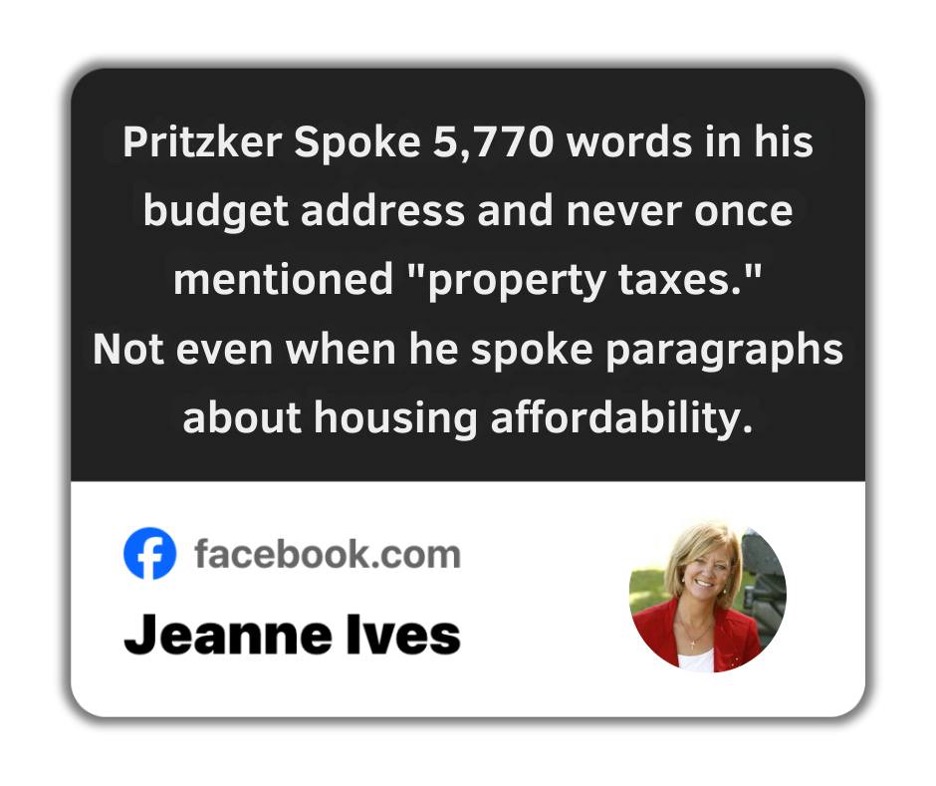
That’s right – not even once did Governor JB Pritzker mention “property taxes” in his 49-minute speech.
And while he was ignoring Illinois residents’ number one complaint, the Florida House of Representatives passed a bill that ELIMINATES property taxes!
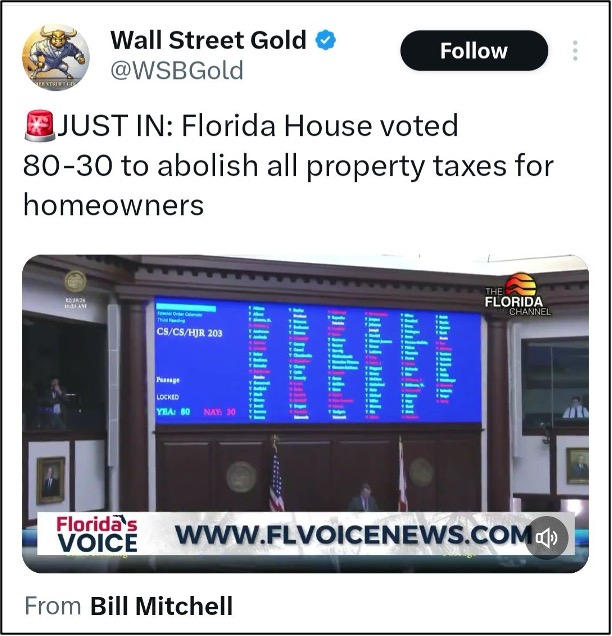
There is much more to cover and fact-check on Pritzker’s address. Here are just a few other items of note:
Pritzker proposed another record budget, tax increases, and by minute six of a 49-minute speech started in on President Trump and the federal cuts in money going to Illinois.
Pritzker’s not wrong. President Trump is cutting the money spigot to Illinois, but we aren’t the only state that is happening to. So far, the Trump administration has proposed at least the following specific cuts or penalties in federal spending to Illinois:
- $1 Billion for childcare services based on the potential for fraud
- $2.1 Billion for CTA Red Line Expansion
- $50 million to CTA over passenger safety concerns
- $100 million for EV chargers
- $700 million in SNAP penalties for lax oversight by Illinois in eligibility
- $128 million loss of federal transportation funds for “systemic failures in how the state issues non-domiciled CDLs – licenses granted to drivers who are not U.S. citizens or permanent residents.” Illinois has 30 days to respond to the federal audit.
- Read the Transportation Department’s report Transportation Department alleges nearly 20 percent of non-domiciled CDLs in Illinois were issued illegally
This list is not exhaustive. New federal rules will lower the amount of funds going to Illinois in other areas like Medicaid, education, food stamps (SNAP), and more.
In case you missed it, Governor Pritzker’s speech can be read in its entirety at this link:
Pritzker covered a lot of areas in his speech, for more analysis, the following links are not behind a paywall and provide more details.
From Illinois Policy Institute: https://www.illinoispolicy.org/pritzker-proposes-record-setting-56-billion-budget/
From Center Square: https://www.thecentersquare.com/illinois/article_b8c30d49-d47b-4ab5-821a-00b7caf09463.html
From ABC 7 News: https://abc7chicago.com/post/illinois-governor-jb-pritzker-deliver-budget-address-springfield/18615380/
Fact Checking Pritzker –There is much more to discuss in this section; here are just three fact checks.
Illinois is not a donor state.
In total, Pritzker claims the federal government is shorting Illinois by $8.4 billion, and it’s not fair because Illinois is a donor state, meaning we send more in tax receipts to the federal government than we receive back in support. That is very much debatable. First, states with military bases and lots of retirees on social security are going to skew the data to make a state look like a “taker” instead of a donor. In fairness, here is a link to a Wallet Hub Study. It shows Illinois is less dependent on the federal government than other states. And here is a link to a comprehensive study by the Rockefeller Institute of Government showing that Illinois is not a donor state. Look at page 20.
Illinois is Not Significantly Better on NAEP Scores Than Other States
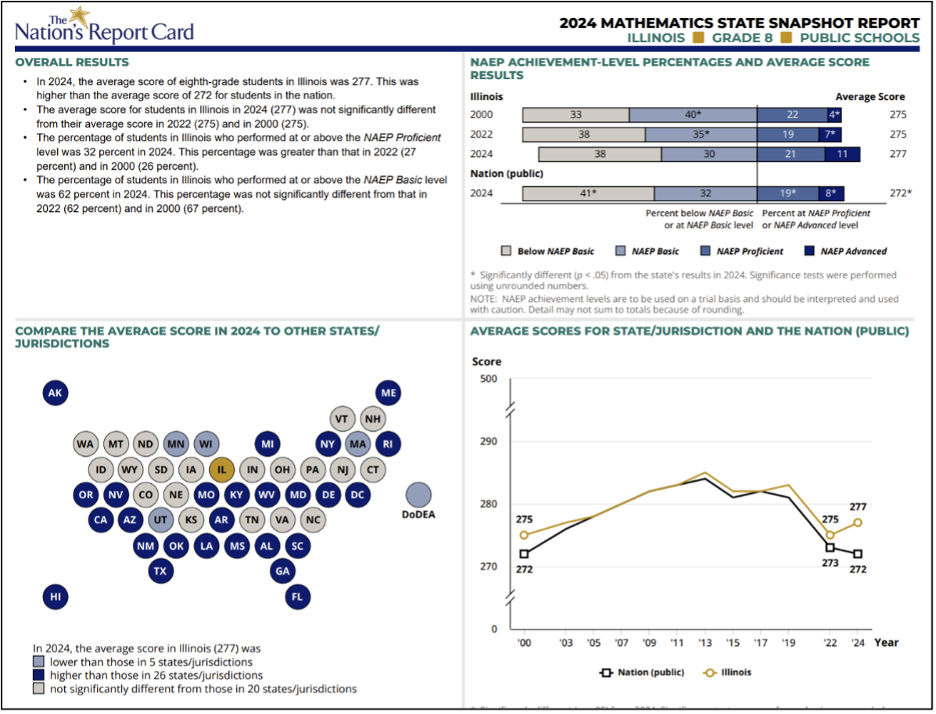
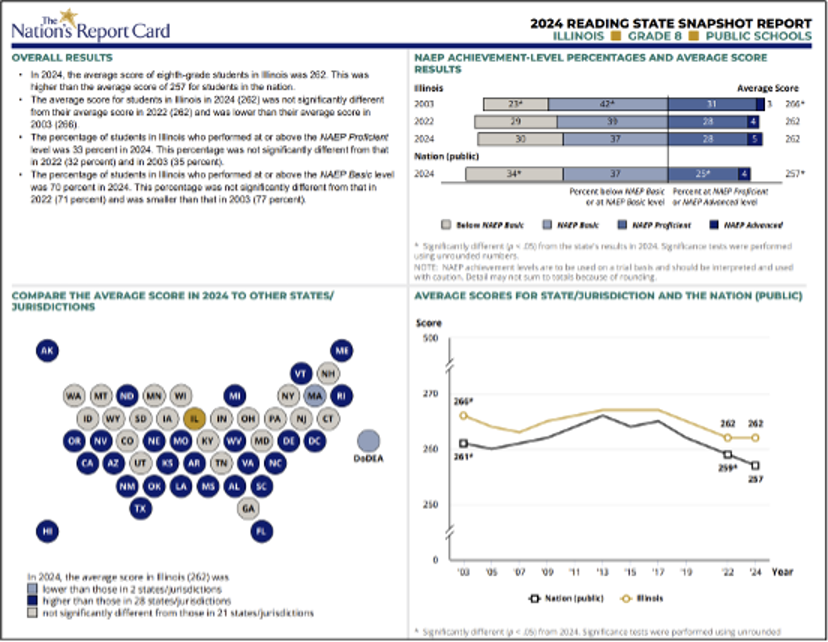
In his budget address, Pritzker said, “The Nation’s Report Card compares all 50 states, and the results are clear. Illinois is among the best in the nation. Only one state outpaced Illinois in 8th-grade reading scores, and only four states outpaced Illinois in 8th-grade math scores.”
I covered this topic in detail in my August 24, 2026, newsletter and noted that, averaging the scores across 4th Grade Math and Reading and 8th Grade Math and Reading, Illinois NAEP scores were not significantly different from those of 28 other states and were lower than those of 6 other states.
And Pritzker used these one-time scores to lower the proficiency cut scores that measure educational progress, so schools look like they are doing better.
Here are the NAEP Charts on 8th-grade reading and math. Read the details on the chart.
Illinois’ financial outlook is shaky.
What Pritzker said:
“We’ve been building a fiscal foundation to ensure that, come hell or high water, including the turbulence of Donald Trump, we can manage through the hard times and nevertheless make progress for a brighter future. Despite the headwinds, the Illinois economy has proven remarkably resilient — forging ahead on our path toward accelerating growth and expansion.”
What Moody’s said just last week. Read the article by Center Square or the full report to the Illinois Commission on Government Forecasting and Accountability. Here are the highlights:
- “Illinois will underperform the region and the U.S. in 2025, with gross state product, employment, and income increasing less than elsewhere,” the report’s summary said. “Growth in the labor force will diminish.”
- “Below average population trends and deep-rooted fiscal problems such as mounting pension obligations and a shrinking tax base represent the biggest hurdles to stronger economic performance,” the summary said. “Persistent out-migration will weigh on the strength of employment and income gains.”
- The state’s unemployment rate averaged 5.3% in the fourth quarter of 2024, compared to 4.1% in the region and the nation. “On the bright side, the rise in Illinois’ jobless rate can be partially attributed to sustained growth in the labor force, which is approaching its pre-pandemic size,” the report said.
- In the long term, the report also notes negative factors.
- “Weak demographic trends and deep-rooted fiscal problems, such as mounting pension obligations and a shrinking tax base, represent the biggest hurdles to the longer-term outlook,” the report said. “The state’s outlook is tarnished primarily by its past budget woes, weak population trends, and high tax burden relative to other states. Overall business costs are only slightly higher than in the U.S., but firms in Illinois tend to pay more in taxes and labor is on the expensive side.”
On the bright side, the report said:
“The state will continue to diversify into service-providing industries while nurturing its more efficient and smaller traditional manufacturing core,” the report said. “Chicago will develop as the transportation and distribution center for the Midwest and will increasingly cultivate its tech industry.” And while Moody’s notes “Illinois has what it needs to remain a top business center,” business costs in the state “are higher than they are nationally and have trended up for the past decade.”