This blog isn’t just another analysis about school performance in Chicago. It’s a warning for people to read past the headlines and not just skim the content of any story coming from the media, especially when the article claims to be a “Best Of” ranking.
Often, stories that are titled “Best Of” capture people’s attention and entice readers to open up the article, wanting to know what ranks at the top. It’s natural that folks want to know who or what is considered the best. We love comparisons and rankings, and anyone associated with politics constantly uses rankings in messaging.
Best places to live or start a business. Best colleges, cars, vacation spots, places to work, movies, products, etc.- many of these rankings are subjective in nature, and we naturally understand that. Whereas if you want to know what the best baseball team is, that ranking is objective – just look at the win-loss record.
Knowing that nobody loves to lie more about how well they are doing than the educational establishment in Illinois and the media that props up their lies, I knew immediately that there are very few schools in Chicago that deserve to be on any “Best Of” list, and so I dug into the numbers.
The Chicago Tribune commissioned a study of the best high schools in Chicago. In ranking the schools, according to their article, the Chicago Tribune used only seemingly objective measures: the percentage of students who are proficient in English Language Arts and Math, the growth in proficiency, attendance, and graduation rate.
To be clear, arguably, there are subjective criteria that weigh into any parent’s decision on the best place to send their own individual student. So, this ranking may not matter to many parents who look at schools for their children based on sports, music, and art programs, proximity to home, or other subjective criteria.
In objectively ranking the schools for “Best Of” criteria, most people would give the most weight to performance on national tests. That’s NOT what the Chicago Tribune did.
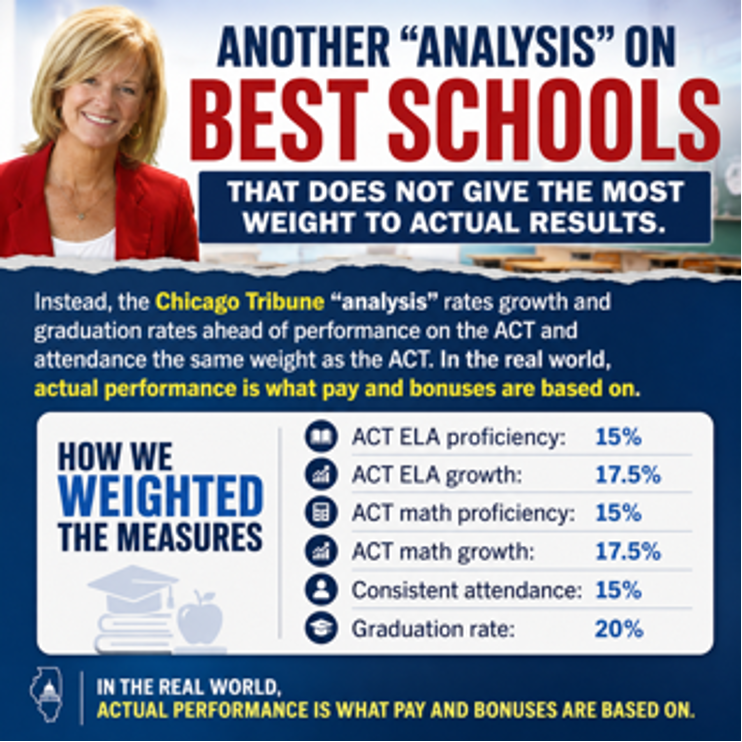
From the article, The Best Chicago Public High Schools, here is what they measured and the weight they gave each metric.
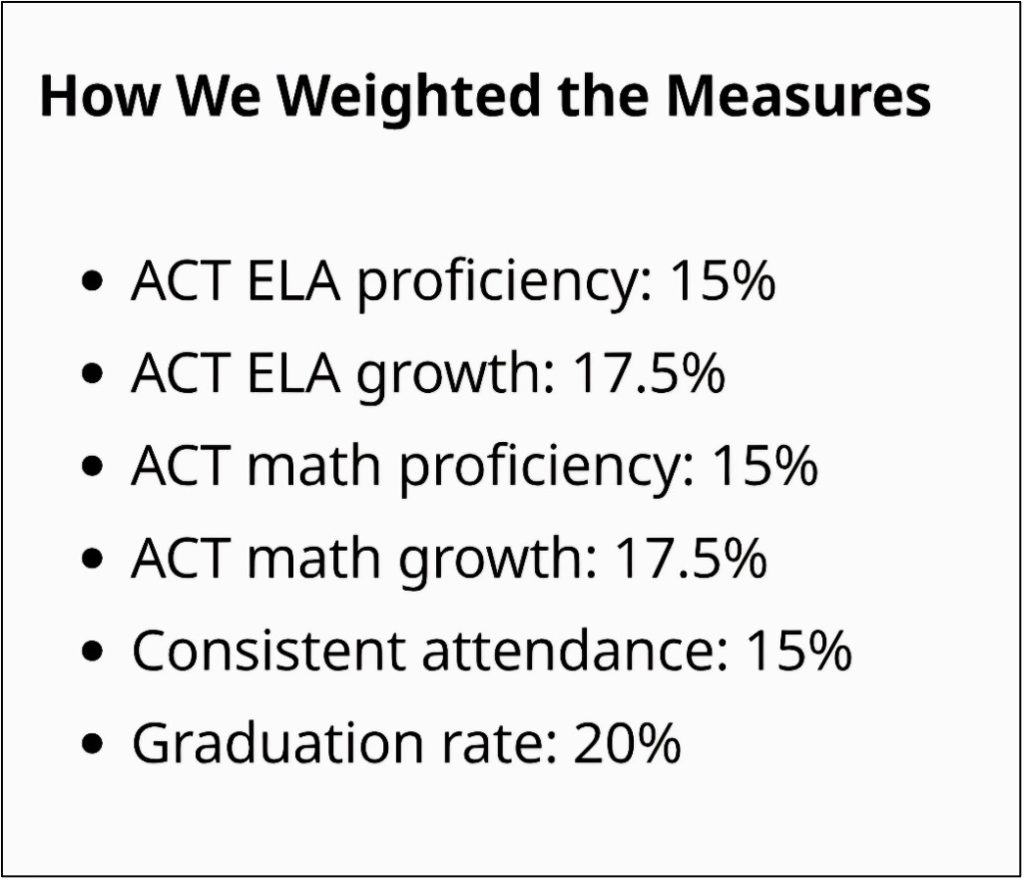
Their “analysis” ranks growth and graduation rates ahead of ACT performance. It gives attendance the same weight as the ACT.
This makes no sense!
In the real world, actual performance is what determines if you are doing your job and how well you rank among peers. Pay and bonuses are based on sales figures, successful project completion, batting averages, and other objective measures – not just showing up.
Graduation rate, by the way, is not at all related to proficiency in Math or English – and the Chicago Tribune knows this. Overall proficiency in the CPS 2024-2025 school report for 11th graders, according to official data from the Illinois State Board of Education, shows that only 40% of students are proficient in English Language Arts and only 25% are proficient in Math. The graduation rate, though, is 82%. Before they adjusted their standards a year ago, the numbers were 23% ELA and 20% Math proficiency, and the graduation rate was still 82%.
The majority of students are passed on from grade to grade and then simply handed a diploma. I dug into the background on the listing of the top 50 schools in the Chicago Tribune to find out just how well these schools are educating their students.
Ranked 50th on the Best Of Public High Schools list is Noble Charter School Muchin College Prep. At that school, only 35% are proficient in ELA, and only 13% are proficient in Math. Their graduation rate is 92.3%.
Ranked #25 – Ogden International High School. 53% proficient in ELA, 21% proficient in Math. Graduation rate of 92.1%
Ranked #15 – Lincoln Park High School. Here is the point in the ranking where finally over 50% of the students are rated proficient in both ELA and Math. At Lincoln Park HS, 74% are proficient in ELA, 50% are proficient Math.
Ranked #1 is Whitney Young. It is a selective enrollment high school, which means students must test into the school, so it is taking the top students from the entire city, and therefore it naturally is going to have higher proficiency than other public schools. At Whitney Young 93.8% of students are proficient in ELA and 92.2% proficient in Math. The graduation rate is 98.2%.
All top five schools in the ranking are selective enrollment. Eight of the top 15 are selective enrollment.
Here’s the point – no school should be on any “Best Of” list if they can’t educate a large majority of their students. And any study that ranks schools should give ACTUAL proficiency the biggest weight in that ranking.
There are likely a number of school administrators and teachers patting themselves on the back right now because the Chicago Tribune put their high school on a Best Of list, but I wonder how many of them will face up to the truth that the majority of the students they graduate aren’t ready for college or even an ability to move into a technical field where math and English skills are required.
Another news article that requires readers to look past the headline and the content comes from the Chicago Sun-Times (and other news outlets, too): West Englewood’s shuttered Charles Warrington Earle School reopens as affordable housing.
The word that stands out in the headline is – of course – Affordable. It’s the political word of the season, and there isn’t a politician on either side who isn’t including the word in every stump speech, mail piece, and conversation with constituents. But affordability is a very subjective term. What is affordable for a millionaire is out of reach for someone making the median income.
More importantly, calling something “affordable” when taxpayers are funding the project at an exorbitant cost is the opposite of affordable – it is instead a scam. And that’s exactly what’s going on with this West Englewood “affordable” housing project.
Excerpts From the Chicago Sun-Times article:
The former Charles Warrington Earle School — one of 50 Chicago schools shuttered in 2013 — is taking on a second life as an affordable apartment building, with roughly a third of its units already leased.
Units include one- and two-bedroom apartments available to households making 60% of the area median income, or AMI. For a Chicago couple, that’s a combined annual income of $58,320.
Nine units are supported by the nonprofit Chicago Low-Income Housing Trust Fund’s MAUI program, making them available for households at 15% AMI. MAUI stands for Multiyear Affordability through Upfront Investment, and the program offers interest-free forgivable loans to replace up to 50% of a developer’s private first mortgage loan, according to the nonprofit.
“This is a working-class development. It is for our working-class neighbors,” Chicago Department of Housing Commissioner Lissette Castañeda said.
The Earle has a community room, computer lab, fitness room, playground, community garden, laundry facilities and green space — amenities that “are not luxuries … [but] what we need to thrive,” Castañeda said.
The nearly $35 million project was supported by $4.2 million in tax increment financing and $540,000 in Chicago Recovery Plan Permanent Supportive Housing funds. The Illinois Housing Development Authority, Federal Home Loan Bank’s Affordable Housing Program and ComEd were also among the financial supporters.
Well, let’s do some math here. Nearly $35 million (real number is $34.9 million) for 50 apartments. That’s $698,000 per one or two-bedroom apartment.
For whom is that affordable??
Look around your town, and I am certain you can find 50 HOMES that taxpayers could buy for half that cost.
We need much more information on these projects, and the Sun-Times and other news outlets should dig in a bit and ask more questions. First and foremost – what other projects could have $35 million be spent on to provide more housing than 50 apartments? There is always an opportunity cost – what were the alternatives in this case?
Here again, the media fails to connect the dots for readers – something the writer could do without editorializing.
The bottom line is that the media is only telling you the facts they want you to know. Brandon Johnson did not bring affordable housing to residents – he scammed the taxpayers. CPS doesn’t have 50 schools that should be on a Best Of list; they have maybe five.
And one of the biggest problems we have in public policy is that the politicians in charge right now don’t ask tough questions, don’t demand better value for money spent, and only pander for headlines to keep a populace too busy to dig into the numbers, ignorant of the wasteful spending being done with their tax money.