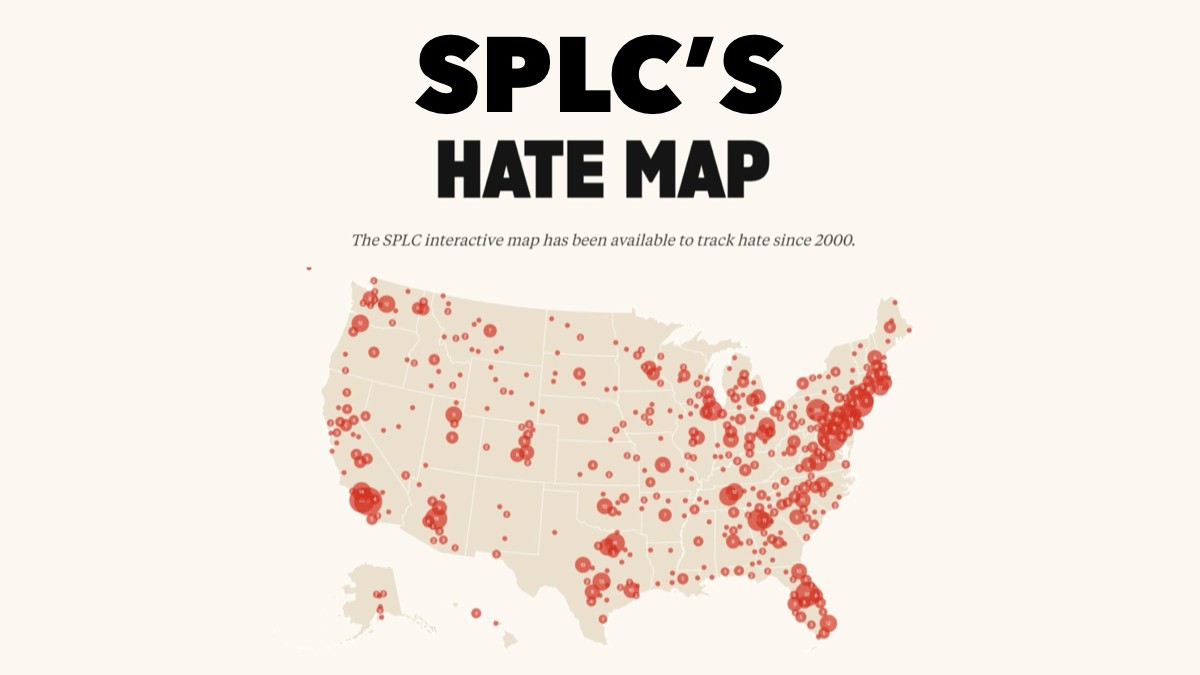
The Southern Poverty Law Center (SPLC) is again in the news for its ethical malfeasance, this time as the defendant in a Justice Department indictment charging the SPLC with eleven federal fraud charges. The indictment summarizes the shocking actions of the SPLC:
The Southern Poverty Law Center’s (“SPL”) stated mission included the dismantling of white supremacy and confronting hate across the country. However, unbeknownst to donors, some of their donated money was being used to fund the leaders and organizers of racist groups, including the Ku Klux Klan, the Aryan Nation, and the National Alliance. The SPLC’s paid informants (field sources”) engaged in the active promotion of racist groups at the same time that the SPLC was denouncing the same groups on its website. The SPLC also had a field source who was a member of the online leadership chat group that planned the 2017 “Unite the Right” event in Charlottesville, Virginia. That field source made racist postings under the supervision of the SPLC and helped coordinate transportation to the event for several attendees. In order to covertly pay its field sources, the SPLC opened bank accounts connected to a series of fictitious entities. The covert nature of the accounts allowed the SPLC to disguise the true nature, source, ownership, and control of the fraudulently obtained donated money the SPLC paid the field sources. In order to keep the scheme going, the SPLC made a series of false statements related to the operation of the accounts.
In response, SPLC interim CEO Bryan Fair claims that “Taking on violent hate and extremist groups is among the most dangerous work there is, and we believe it is also among the most important work we do.”
SPLC employees are kinda, sorta like Army Rangers.
The SPLC regularly publishes both its “Hate Map” and a list of “extremist” groups. Alliance Defending Freedom, Liberty Counsel, Family Research Council, and American Family Association are listed as “hate” groups. TPUSA, Focus on the Family, and PragerU are listed as “extremist” groups. So, if by “dangerous work,” the SPLC means their work poses a danger to the country, to freedom, and to faith, I agree.
As reported by the Guardian, “Andrew Tessman, a former federal prosecutor who handled financial fraud cases” believes the DOJ might prevail:
One area where prosecutors might have success is in looking at what representations the SPLC had made to banks. Tessman noted that prosecutors had not technically filed bank fraud charges against the SPLC, but rather charged them with making a false statement to a bank. “It’s an underused but powerful statute. It just requires an intentional false statement to a bank. If it is true that the SPLC set up false entities and the bank was not aware of it, they could succeed on those charges.”
In my former job as culture writer for the Illinois Family Institute (IFI), I unfortunately had occasion to interact with two dubious former SPLC leaders, Mark Potok and Heidi Beirich. They were the activists in charge of what was laughingly called the Intelligence Report. What follows is the true story of my interactions with the SPLC—a story I recounted first in 2017 and bears repeating.
I began working for IFI just after Labor Day in 2008. In early March 2009, I learned that IFI had been put on the Southern Poverty Law Center’s (SPLC) “hate” groups list.
Since IFI stood unequivocally opposed to both violence and hatred, I wondered why it was listed as an “anti-gay” hate group when other institutions like the Roman Catholic Church and many Protestant denominations that share the same views on matters related to homosexuality were not.
For clarification I called the SPLC and spoke with Heidi Beirich. Our conversation was troubling in that Beirich revealed that even a tenuous, remote connection to anyone who has made statements the SPLC doesn’t like will land an organization on their hate groups list.
Beirich told me that the only reason IFI had been included on the hate groups list was that in 2005, a former IFI executive director had reposted a very short article by someone not affiliated with IFI.
Although there were no defamatory comments in the short piece, Beirich claimed that in other articles that never appeared on IFI, the author had suggested that, in Beirich’s paraphrase, “Gays are sickly, and people should stay away from them.”
I had no idea if Beirich’s claim about this author were true, but if it were, I would have found it inconsistent with Scripture and rejected it. The problem was IFI had never cited or endorsed such rhetoric, and yet the SPLC had labeled IFI as an active “hate” group based on it.
Beirich’s rationalization for naming IFI a hate group was that in the short article IFI had re-posted four years earlier, the author had claimed that homosexual men have shortened lifespans—a claim that Beirich viewed as incorrect. I responded that I could see how a statistic could be erroneous and derived from flawed methodology, but I didn’t see erroneous statistics as inherently defamatory or hateful.
More important, the same finding regarding reduced life expectancy for homosexual men had been reported by a world-renowned medical journal and cited as true by homosexual activists when it served their purposes.
That study, which appeared in Oxford University’s International Journal of Epidemiology, concluded that “In a major Canadian centre, life expectancy at age 20 years for gay and bisexual men is 8 to 20 years less than for all men. If the same pattern of mortality were to continue, we estimate that nearly half of gay and bisexual men currently aged 20 years will not reach their 65th birthday.”
Following my exposé of the reason for the SPLC’s inclusion of IFI on the “anti-gay” hate groups list, the SPLC received complaints, which evidently miffed the SPLC.
As a result of those complaints, the former editor of their ironically named “Intelligence Report,” which includes the hate groups list, Mark Potok, began leaving curious voice messages around the country for those who had called to complain.
Here’s a transcription of one of Potok’s messages:
Yes, Hi, this is a message for . . . from Mark Potok, Southern Poverty Law Center. Very briefly, I just wanna say very briefly – we do list them (Illinois Family Institute) for a reason, which we’ve stated publicly. They (IFI) have been less, in my opinion, than honest about what we really said. They publish and promote the work of a man named Paul Cameron. Paul Cameron is a guy who is infamous for over the last 20 years for producing, for publishing fake studies that allege all kinds of terrible things about homosexuals. For instance, that gay men are, something like, 20 times more likely to molest children; that gay men have an average death age of something like 43 because they’re so sickly and, ya know, sorta do such terrible things. These things are completely false and have been proven false long ago. Our view is that the Illinois Family Institute promotes these complete falsehoods. Then that is hateful activity. We never list any group on the basis of simply disagreeing morally or otherwise with homosexuality. We told the Illinois Family Institute directly that if they remove this material from their website, in fact, that we would take them off the list. Instead, what they’ve done is essentially launched an attack on us to try to get people to call us as you did. Anyway, that’s all. I just wanted to at least briefly explain that it was not quite the way it was being portrayed.
Contrary to Potok’s claim that the SPLC had publicly stated their reason for including IFI on their “anti-gay” hate groups list, prior to my phone call to them, they had never publicly stated their reason. And stating their reason in a private phone conversation with just me didn’t constitute a public statement.
After I heard his voice message in which Potok stated that IFI had “been less than honest,” I called and spoke to him, informing him that in my article, I had been scrupulously honest about what Heidi Beirich had said to me. In fact, I even included a follow-up email in which Beirich confirmed the reason for the SPLC’s inclusion of IFI on the SPLC’s “hate” groups list.
Mr. Potok stated in his voice message that “they publish and promote the work of a man named Paul Cameron.” This grossly misrepresented the nature of IFI’s involvement with Cameron’s work. It suggested that IFI regularly or continually published and promoted his work, when, by Potok’s and Beirich’s own admission, IFI published only one brief article three years prior to being added to the “hate groups” list.
More troubling yet, this one article contained no statements remotely like those that Potok claimed it did: “gay men are, something like, 20 times more likely to molest children” or that “they’re so sickly and, ya know, sorta do such terrible things.”
Potok dug himself in even deeper when he said in his voice message that it is the SPLC’s view that “the Illinois Family Institute promotes these complete falsehoods.” He was saying that IFI promotes falsehoods that the SPLC’s own evidence proves we did not promote. The SPLC’s own evidence was the one four-year-old article that did not include any references to “child molestation,” or “sickly homosexuals sorta doing terrible things.”
In plain language, Potok was lying.
I asked Potok if IFI had been on the SPLC’s hate groups list since 2005 when the challenged article was posted. He replied “No.” I then asked when we were first listed, and he said 2008. So, they added us to their list in 2008 based on one brief article posted in 2005. Coincidentally, I started writing for IFI in 2008.
In order to expose the deceit of the SPLC, IFI took down the offending article in 2009, and the SPLC took us off the hate groups list. Then in 2010, we were back on. What happened in 2010?
Well, in 2010, Potok and his accomplices Heidi Beirich, Evelyn Schlatter, and Robert Steinback finally got around to manufacturing criteria for determining what constitutes a “hate group.”
In 2010, the SPLC invented a definition of “hatred” that was elastic enough to allow the inclusion of organizations the SPLC hates. The dubious criteria dubiously applied focus on social science research or propositions that the SPLC doesn’t like.
Schlatter explained that the “propagation” of “known falsehoods” about homosexuality would result in organizations being included on the SPLC’s “anti-gay” list and perhaps also on their hate groups list.
I’m not sure if the anti-Christian activists at the SPLC actually understood what a “known falsehood” (also called a lie) is. A known falsehood is a statement that is objectively, provably false and is known to be false when made.
So, let’s take a closer look at just four of the ten “known falsehoods” that Schlatter and co-author Robert Steinback cite in their companion article “10 Anti-Gay Myths Debunked.”
Alleged falsehood about hate crimes legislation and the repeal of DADT
The SPLC said that if an organization argues that hate crime legislation may result in the jailing of pastors who condemn volitional homosexual acts as sinful, the organization is guilty of “anti-gay” hatred and will be included on the SPLC’s hate groups list. And any organization that argues that allowing homosexuals to serve openly in the military will damage the military merits inclusion on its “anti-gay” hate groups list.
How can the SPLC sensibly claim that speculation that hate crimes legislation may lead to the jailing of pastors who condemn homosexuality constitutes a known falsehood? It is a prediction of possible future events that may result from the logical implications of a law. This prediction may not come to fruition, but it cannot reasonably be deemed a “known falsehood.”
And how can a prediction about the effects of allowing homosexuals to serve openly in the military be a known falsehood? Certainly, there are differences of opinion on the effects of the repeal of Don’t Ask, Don’t Tell, but liberal speculation that such a change will not damage the military is not a known truth.
Alleged falsehood concerning mental illness and drug use among homosexuals
According to the SPLC at the time, if any organization states that homosexuals experience higher rates of depression or drug use, it might land on the hate groups list. The SPLC engages in some tricksy rhetoric to defend this criterion. Schlatter and Steinback argue that mental health organizations no longer consider homosexuality a mental disorder, which is true but has no relevance to the fact—which even the SPLC concedes—that homosexuals experience much higher rates of mental illness and drug and alcohol abuse than the general population.
What really sticks in the craw of the SPLC is that conservative organizations don’t agree with the unproven speculation by the SPLC and some social scientists that the reasons for the increased incidence of mental disorders and drug use are social stigma and “discrimination.”
Alleged falsehood about children raised by homosexuals
The SPLC deems hateful the claim that same-sex parents harm children. Potok and his minions didn’t define harm and apparently rejected a whole body of social science research that claims that children fare best when raised by a mother and father in an intact family. Even President Obama in his Mother’s Day and Father’s Day proclamations argued that both are essential to the welfare of children.
While homosexual activists exalt even the most poorly constructed social science research if it reinforces their presuppositions, they reject better constructed studies that undermine them. If organizations don’t accept the ever-fluid, controvertible, and highly politicized social science research that the SPLC favors, they go on the “hate group” list.
Alleged falsehood about persons who choose to leave homosexuality
According to the SPLC, if an organization claims that people can “choose to leave homosexuality,” it risks being added to the hate groups list. But there exist people who choose to stop engaging in homoerotic activity, choose to leave homoerotic relationships, and choose no longer to place unwanted homoerotic attraction at the center of their identity. There are former homosexuals, like Rosaria Butterfield, who are now happily married to opposite-sex persons. How can making a true statement about the possibility that humans can make choices about their sexual identity be construed as a known falsehood or hateful?
These are just some of the views of the long-corrupt SPLC—an organization that the Justice Department has just revealed is so devoid of ethics that it’s been secretly exploiting its own donors to keep hate and hate hoaxes alive in order to smear the people they hate.