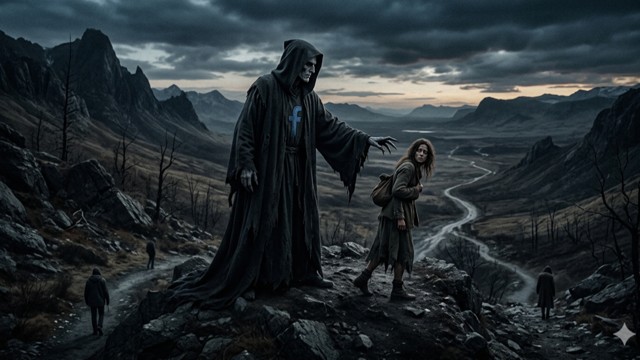
I was notified via email late Tuesday night that my personal Facebook account has been suspended because Facebook “received a notice from a third party that it infringes their copyright.” Apparently, I violated Facebook’s terms of service when I used one publicly available photo from someone’s publicly available Instagram account to accompany an article I had written about her and the public library for which she works. I had reposted the article on my personal Facebook page.
The woman who notified Facebook is Rosario Zavala, the Adult Services Librarian at my local library, the West Chicago Public Library. I wrote about her in May 2026 in an article titled “Illinois Taxes Are Being Used to Celebrate Homosexuality.”
I did not know that I had violated Facebook’s terms of service. I did not know I had infringed Zavala’s copyright. I was under the mistaken belief that it was legal to share images made public by the owner. I wrongly believed that if I was not selling the image, it was legal to repost it. And I mistakenly believed that using one publicly available photo to accompany political commentary was covered by the Fair Use doctrine. I suspect I am not alone in my ignorance of intellectual property law.
As one example of someone who is similarly ignorant, Illinois State Representative Kelly Cassidy has not only been using my original writing but also using it to fundraise. She has taken my original copyrighted writing, put it on t-shirts and mugs to sell for her campaigns. And she has publicly posted images of her products with my copyrighted quotes on social media. Cassidy, who has worked as a legislative liaison in the Cook County state’s attorney’s office and was the director of programs and development for the state’s attorney’s office, apparently knows as little about copyright law as I did until last night.
But, as the aphorism goes, “ignorance of the law is no excuse.”
Even though Rosario Zavala has my phone number from our May conversation detailed in my article, she never contacted me to inform me that I had violated her copyright or to request that I delete the photo. Facebook never notified me that I had violated the terms of service, that I needed to delete the photo, or that I risked being permanently banned.
I can no longer access my Facebook account. I can’t access Facebook messenger. I can’t access photos and memes, including those I made in the wake of my husband’s death from cancer. I can’t notify my Facebook friends to let them know what has happened. I can’t thank them for their friendship and for the kind words and prayers for me and my family as one of my daughters is in a brutal fight for her life against cancer.
Instead, if my friends try to visit my Facebook page, they find a dishonest message from Facebook that says,
This content isn’t available right now
When this happens, it’s usually because the owner only shared it with a small group of people, changed who can see it or it’s been deleted.
What the FB overlords should have is a message that says,
This account has been suspended by Facebook.
Social media is replacing legacy media as the place where Americans access news and commentary. After decades of leftist control, manipulation, and censorship of news and commentary, conservatives finally found their way around the intolerant propagandists. Conservatives now have a means of expressing their views on cultural and political matters, at last to have a voice in the public square.
I’ve had a voice on social media for years. I have many friends and exponentially more followers who, thanks be to God, value my perspective. And I equally value the perspectives of my friends. Then in an instant with no warning, I lost that platform, that opportunity to be a cultural contributor, because of one mistake.
Without an opportunity to explain; thank them for the laughs, tears, and other memories; and bid farewell, I fear Facebook friends will think I have unfriended and blocked them. That hurts.
It’s difficult to explain the emotions I’m experiencing to those who lead busy lives of delightful social chaos. As a widow with grown children, Facebook has become a place of familiar conversation—the kinds of brief, daily chats you have when married and, if so blessed, raising kids. Spouses chat countless times throughout days and evenings about their family, friends, faith, health, music, movies, and the issues and events of the day. Imagine one day being told those conversations are over.
In 2017, Mark Zuckerberg made several public statements emphasizing the capacity of Facebook to foster connection, including this:
We want to help one billion people join meaningful communities. If we can do this, it will not only reverse the decline in community membership we’ve seen around the world, but it will also strengthen our social fabric and bring the world closer together.
Apparently, little thought went into the devastating social and emotional effects on people of abruptly casting them out of the metaverse.
Because of one inadvertent and easily corrected mistake on my part, Zuckerberg just shredded the social fabric that has been tying my broken pieces together.