It’s time to pay up for all that money spent during the elections.
After winning historic margins in the Illinois legislature, the unions are flexing their power in Springfield, and outgoing Speaker Welch resurrected a bill that was sidelined during the Spring session and advanced it out of committee.
HB 2565, sponsored by Democrat State Rep. Dave Vella from Rockford, would allow striking workers to receive unemployment benefits after two weeks of a strike.
I am wondering why the two Republicans on the Rules Committee that let the bill come back from the dead, outgoing State Reps. Norrine Hammond and Ryan Spain from the Peoria area, voted with the Democrats to put it back on the calendar – perhaps the vote was done as a package with other actions on bills. But no one in their right mind would allow this bill to go forward.
How quickly the Democrats forget that IDES let $5.2 billion in unemployment fraud happen during COVID!
The system required employers to pay more to shore up the fund. The entire department is inept, and now employers will be bled even more if this bill goes forward.
A Chicago Tribune editorial called the policy “wrongheaded on multiple levels.”
“With strikes likely lasting longer as a result and the state’s unemployment insurance fund tapped to pay picketing workers, taxes on employers to keep the fund at a healthy level easily could rise. State and local taxes on Illinois employers already are punishing enough.
The policy also quite obviously would hamper the state’s ability to attract new employers, particularly manufacturers. “It just gives Illinois another black eye when it comes to economic development,” Illinois Manufacturers’ Association President Mark Denzler tells us.”
The editorial, interestingly, singled out the potential harm to grocers if the bill were to pass.
“Worried about food deserts? Most grocery workers are unionized, and profit margins at stores are thin. Debilitating strikes — or even concerns that state policy is encouraging them — could well prompt the closure of more stores.
Even without this legislation, Illinois Retail Merchants Association President Rob Karr tells us, “We spend a lot of time trying to keep grocers from pulling the plug.”
I wonder if that’s because the taxpayer-funded Prairie Food Co-Op in Lombard made national news for failing after 16 months. The founders of the store, Kathy and Jerry Nash, wanted “to prove that we’re not just some well-meaning hippies,” when they opened the store, as related in this glowing article in the Daily Herald about the “community-owned” store.
For whatever reason, the story of its closing, got picked up nationally.
The Washington Times: https://www.washingtontimes.com/news/2026/nov/17/government-funded-grocery-store-illinois-closes-due-low-sales/
Townhall: https://townhall.com/news/amy-curtis/2026/11/18/prairie-food-co-op-n2686665
Jonathan Turley: https://jonathanturley.org/2026/11/19/a-difficult-decision-unsustainable-cooperative-closes-outside-chicago-despite-federal-and-state-funding/
There’s no doubt this story had legs because Socialist mayors like Zorhan Mamdani and Brandon Johnson wanted wholly-owned government-run grocery stores.
This type of encroachment on the private sector is anathema to America’s founding principles. No politician – from either party – should put taxpayer money at risk in this way.
Of course, while I appreciate the scrutiny on the $1.5 million that went to Prairie Foods Co-Op, a much bigger problem is the $536 million that Gotion is getting and the $827 million in subsidies Rivian was awarded. I’m not sure either company has turned a profit yet from their Illinois operations.
One more point on this, Congressman Sean Casten is challenging Maxine Waters for Chairman for the House Financial Services Committee. In his Facebook post about awarding Prairie Foods Co-Op $750,000 in taxpayer money, he said it would create “economic and environmental benefits” for the community. If this is his idea of a good investment, then he shouldn’t be the chairman of anything to do with finances.
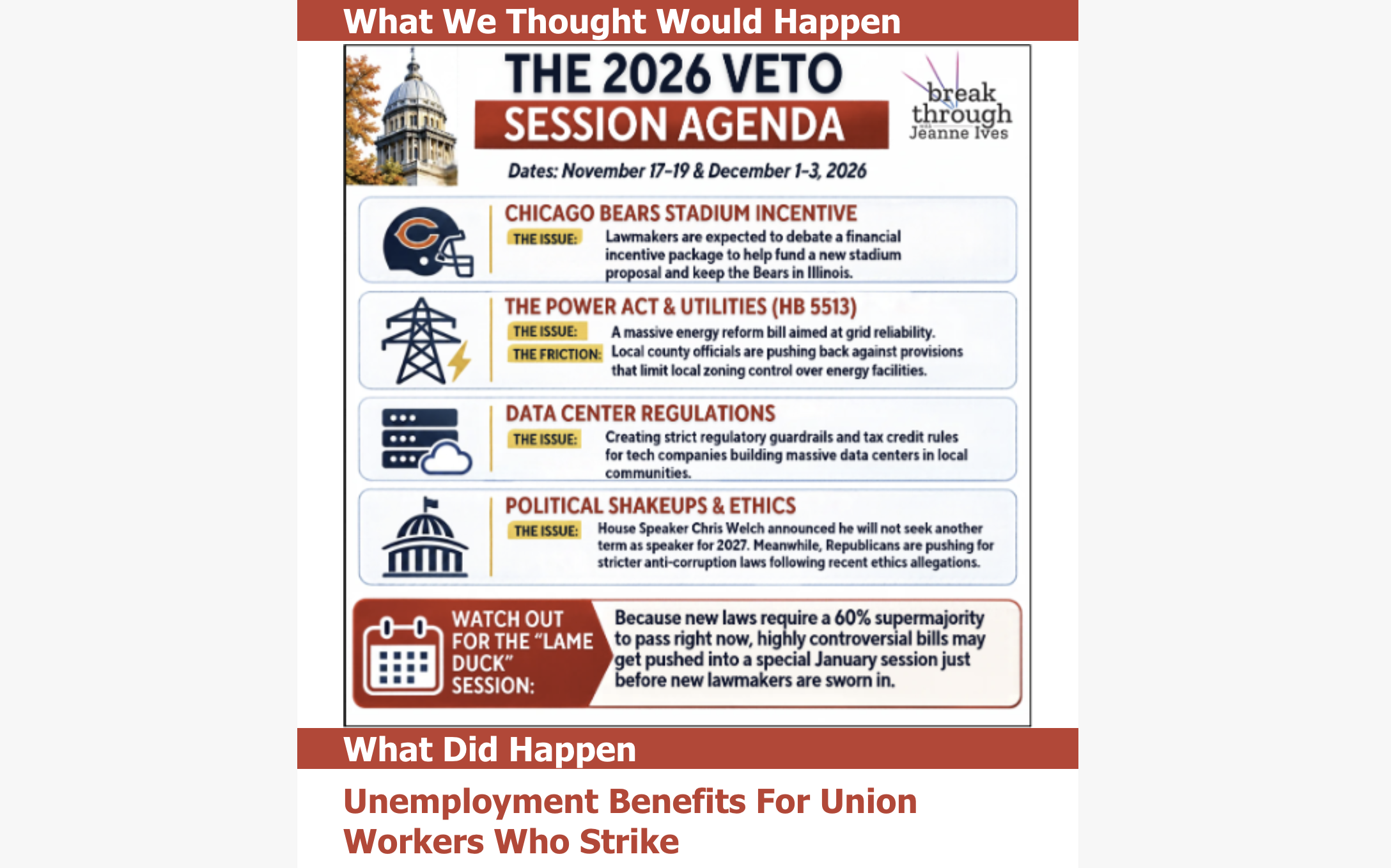
Back to Veto Session – The legislature is back in session on December 1st for three days. It is more than likely that every issue noted in the graphic above remains unresolved.
The IL Senate had a lengthy hearing on the Power Act on Wednesday (I listened to all 2.5 hours) and there was a lot of disagreement on what a final bill should look like. If the bill gets rammed through after Thanksgiving, then it is the environmentalists and the renewable industry that won.
The bill is over 600 pages long and would require data centers to bring their own ”renewable energy” to support operations. This physically is not possible for data centers, so they just won’t locate here anymore.
Outrageously, the renewable power proponents suggested that the power could be accounted for by having people and businesses back off on usage when power demands exceed grid capacity. That’s their solution?!
You go without power – because they insist that only expensive wind, solar, and battery power be allowed for data centers (nuclear, too, but that’s a long way off)